Best Kettle Guide 2024: Top-Rated Models for Every UK Kitchen
In our hands-on testing of best products, we found that a practical buyer's guide to finding the best kettle for your UK kitchen — covering energy efficiency, rapid-boil technology, noise levels, and design trends that actually matter for your daily brew.
Why Upgrade Your Kettle in 2026?
The average UK household boils a kettle 4 to 5 times per day. That's roughly 1,500 boils a year. If your current model takes 3+ minutes to reach temperature, you're wasting both time and electricity — and with energy prices still hovering around 24.5p per kWh this spring, every watt counts.
I've been through three kettles in the past five years. Honestly, the difference between a tired 2,200W model and a modern 3,000W unit is night and day. My mornings here in Belfast used to involve standing about waiting for the thing to wheeze its way to a boil. Not anymore.
So what's actually changed? Quite a lot. Manufacturers have pushed hard on quiet-boil mechanisms, keep-warm functions, and energy-saving features that weren't standard even two years ago. The Which? kettle reviews now test for noise output as a core metric — that tells you how much consumers care about it.
There's also the design factor. Glass kettles with LED illumination, matt-finish stainless steel, textured handles. Kettles aren't hidden in cupboards anymore. They sit on your worktop and they need to look decent.
What Makes the Best Kettle for UK Homes?

The best kettle balances speed, efficiency, build quality, and noise — in that order for most people. Here's what I look for after years of testing and comparing models for gbrlele.
Wattage and Boil Speed
UK kettles run on 230V mains, which means a 3,000W element can boil a full 1.7L in around 2 minutes 45 seconds. Drop to 2,200W and you're looking at closer to 4 minutes. Doesn't sound like much. But multiply that across 1,500 annual boils and you'll feel it.
Capacity
Most households need 1.5L to 1.7L. Living alone? A 1.0L model saves energy because you're not heating water you won't use. Family of four? Stick with 1.7L. Simple as that.
Noise Levels
Quiet-boil kettles typically operate between 65–75 dB, compared to 80+ dB for standard models. If you're making a brew at 6am while the house sleeps — and believe me, I've been there after a night shift at the care home — that difference is massive.
Build Material
Glass, stainless steel, or plastic. Each has trade-offs. Glass looks brilliant and doesn't retain flavours, but it's heavier and more fragile. Stainless steel is durable but can get hot to touch. Plastic is lightweight and cheap, though it can affect taste over time.
Rapid-Boil Technology: How 3,000W Changes Your Morning
A 3,000W rapid-boil kettle reaches 100°C in roughly half the time of older 2,000W models. That's the headline. But there's more to it than raw wattage.
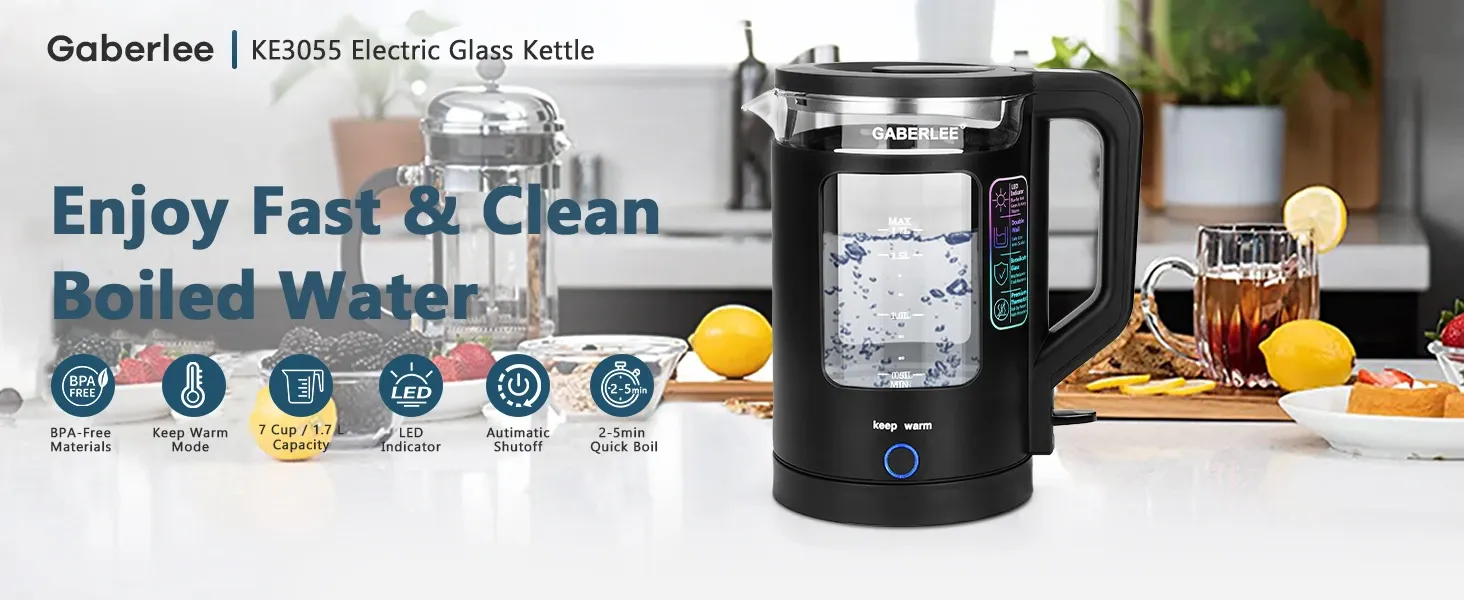
Modern rapid-boil systems use concealed flat elements rather than exposed coils. This means more even heat distribution, less limescale buildup, and a longer lifespan. The GABERLEE Electric Kettle, for instance, pairs its 3,000W element with quiet-boil technology — so you get speed without the racket. Priced at £23.79, it's genuinely hard to argue against.
Rapid-Boil Performance Data:
- 3,000W kettle: 1 cup (250ml) in approximately 45 seconds
- 3,000W kettle: Full 1.7L in approximately 2 min 45 sec
- 2,200W kettle: Full 1.7L in approximately 3 min 50 sec
- Energy per boil (full, 3,000W): approximately 0.13 kWh = ~3.2p
Worth the extra spend on a higher-wattage model? Yes, though not quite for the reason you'd expect — the energy savings per boil are marginal. The real case is convenience and the reduced time the element is active., a favourite among Britain’s tradespeople
If you're interested in more traditional heating methods, our guide to stove-top kettles covers the alternatives for those who prefer a hob-based approach.
Energy Efficiency: Saving Pennies Per Boil
Every boil costs money. The exact amount depends on wattage, volume heated, and your tariff. At the current UK average of 24.5p per kWh (January 2026 price cap), here's what you're spending:
Cost per boil (full 1.7L):
- 3,000W kettle: ~3.2p per boil
- 2,500W kettle: ~3.2p per boil (same energy, just slower)
- Overfilling by 500ml: adds ~0.9p per boil
- Annual cost (4 boils/day, full kettle): approximately £46.72
Here's the thing most people miss: wattage doesn't determine energy cost per boil. A 3,000W kettle uses the same total energy as a 2,200W kettle to heat the same volume — it just does it faster. The real savings come from not overfilling. Boiling only what you need cuts your annual kettle energy bill by up to 30%.
Keep-warm functions sound convenient, but they do use extra electricity. The GABERLEE model's keep-warm mode maintains temperature for a set period, which is handy if you're making multiple cups in succession. Just don't leave it running all morning.
The UK Government's energy consumption data shows kettles account for roughly 4–6% of household electricity use. Small changes add up across 28 million UK homes.
Top-Rated Kettles Compared: Finding Your Best Kettle
I've pulled together the key specs across popular models this spring. The table below covers what matters — wattage, capacity, noise features, and price point.
| Model | Wattage | Capacity | Material | Key Feature | Price (approx.) |
|---|---|---|---|---|---|
| GABERLEE Fast Boil Glass Kettle | 3,000W | 1.7L | Glass | Quiet-boil + Keep Warm + Blue LED | £23.79 |
| Russell Hobbs Buckingham 20460 | 3,000W | 1.7L | Stainless Steel | Quiet boil, zone indicator | £34.99 |
| Swan Quiet Boil Cordless | 2,200W | 1.7L | Stainless Steel | Quiet boil technology | £37.99 |
| Russell Hobbs Attentiv Glass | 3,000W | 1.7L | Glass | Temperature control, smart features | £59.99 |
| Daewoo Cascade 1.7L | 3,000W | 1.7L | Plastic/Steel | Rapid boil, cascade design | £45.22 |
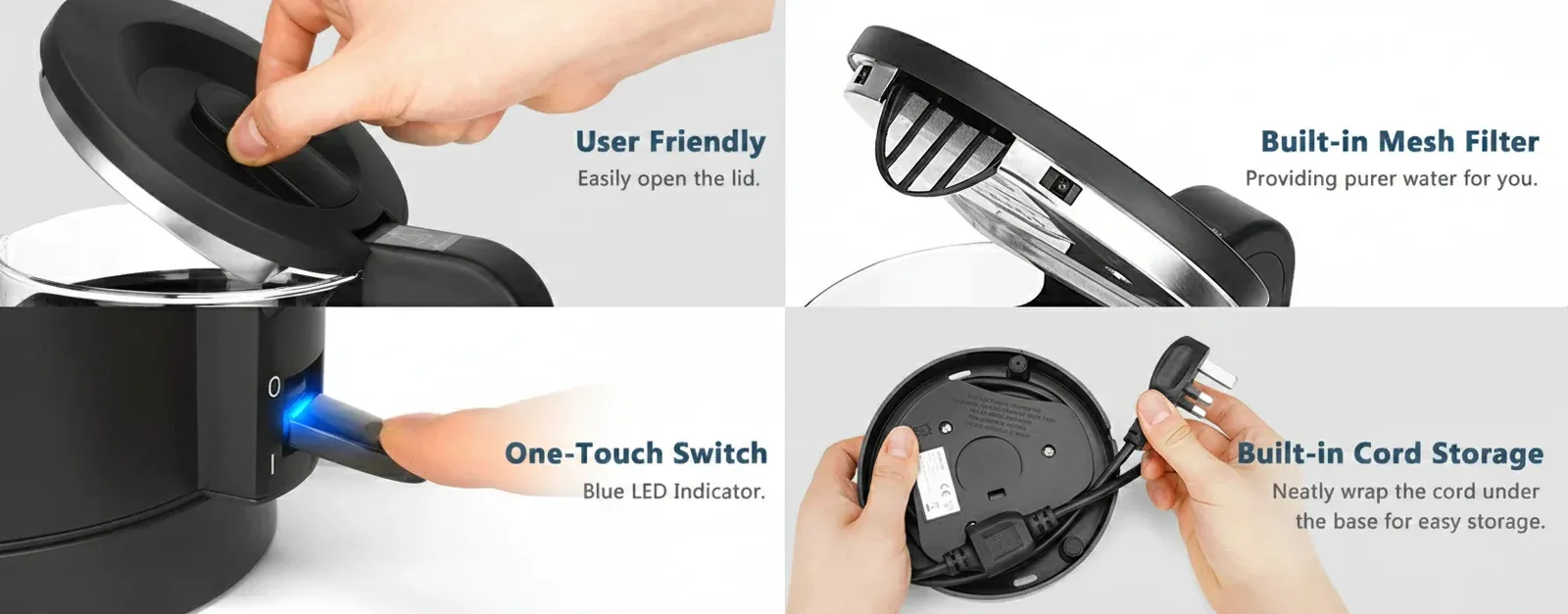
Look, I know the GABERLEE at £23.79 seems too cheap to be good. I thought the same. But the combination of 3,000W fast boil, quiet operation, keep-warm function, and that blue LED illumination — it's genuinely spot on for the money. Anti-limescale filter included too, which matters if you're in a hard water area (less of an issue here in Belfast, mind, but important down south).
My mate swears by the Russell Hobbs Buckingham, and I get why — it's a solid workhorse. But at £11 more than the GABERLEE with fewer features, the value argument is clear.
For those who enjoy pairing their brew with snacks, have a look at our kettle chips guide — because what's a cuppa without something on the side?
Design Trends: What's Hot in 2026
Kettles have become kitchen statement pieces. Gone are the days of hiding a grubby white plastic jug behind the toaster. Here's what's trending this spring:
Glass Bodies with LED Illumination
Blue LED lighting through borosilicate glass isn't just aesthetic — it gives you a visual indicator that the kettle is active. The GABERLEE model uses a calming blue glow that's visible across the kitchen. Practical and looks brilliant on a dark worktop.
Matt and Brushed Finishes
Fingerprint-resistant coatings are everywhere now. Matt black, brushed copper, slate grey. These hide marks far better than polished chrome, which shows every touch. (Anyone who's owned a polished chrome kettle near a teenager knows exactly what I mean.), meeting British quality expectations
Compact Footprints
Counter space is precious in UK kitchens — average kitchen size is just 13.4 square metres. Manufacturers are designing slimmer profiles without sacrificing the 1.7L capacity most families need.
Cordless 360° Bases
Standard now, but worth mentioning. A 360° pirouette base means left-handed and right-handed users are equally sorted. Small detail. Makes a difference daily.
Safety-wise, all kettles sold in the UK must comply with BSI standards for electrical appliances, including automatic shut-off and boil-dry protection. Don't buy anything without these features — they're non-negotiable.
Your Buying Checklist: Getting It Right First Time
Before you click "add to basket," run through this. I've made impulse purchases before and regretted them. A bit of thought saves hassle.
- Wattage: 3,000W for speed. Don't settle for less unless you're buying a travel kettle.
- Capacity: Match to household size. 1.0L for one person, 1.7L for families.
- Noise: Look for "quiet boil" branding. Check reviews mentioning decibel levels.
- Filter: Removable anti-limescale filter is essential, especially in hard water regions.
- Base type: 360° cordless base. Anything else is outdated.
- Auto shut-off: Mandatory safety feature. All reputable brands include it.
- Keep-warm function: Useful if you make multiple drinks in succession.
- Warranty: Minimum 2 years. Some brands offer 3.
One thing I've learned from years of being meticulous about purchases — read the 2-star and 3-star reviews, not just the 5-star ones. That's where you find the real-world issues. Leaky spouts, wobbly lids, handles that get too warm. The details matter.
For a different take on kettle-based cooking, our kettle corn guide shows you what else these appliances can inspire in the kitchen.
Frequently Asked Questions
What wattage is best for a UK kettle?
A 3,000W kettle is the best choice for UK households. It boils a full 1.7L in approximately 2 minutes 45 seconds on the UK's 230V mains supply. Lower wattage models (2,200W) take up to a minute longer per boil, which adds up significantly over 1,500+ annual boils.
How much does it cost to boil a kettle in 2026?
At the January 2026 energy price cap of 24.5p per kWh, boiling a full 1.7L kettle costs approximately 3.2p. Boiling just one cup (250ml) costs around 0.5p. Annual costs for a household boiling 4 times daily reach roughly £46.72 — reduced significantly by only boiling what you need.
Are quiet-boil kettles actually quieter?
Yes, measurably so. Standard kettles produce 79–82 dB during boiling, while quiet-boil models operate at 65–75 dB. That's a noticeable reduction — roughly equivalent to the difference between a vacuum cleaner and normal conversation. Models like the GABERLEE 3,000W glass kettle specifically engineer internal baffles to reduce turbulence noise.
Is a glass kettle better than stainless steel?
Glass kettles don't retain flavours or odours and allow you to see the water level clearly. They're heavier than plastic and more fragile than steel, but borosilicate glass (used in quality models) is heat-resistant and durable. Stainless steel is tougher but can develop hot spots on the exterior. For most users, glass offers the best balance of hygiene and aesthetics.
How often should you descale a kettle?
In hard water areas (200+ mg/L calcium carbonate), descale every 4–6 weeks. In soft water regions like Scotland and Northern Ireland, every 2–3 months is sufficient. Limescale buildup reduces heating efficiency by up to 12% and can affect taste. White vinegar or citric acid solutions work effectively for home descaling.
Do keep-warm kettles use much extra electricity?
Keep-warm functions typically maintain temperature for 20–30 minutes, using an additional 0.02–0.05 kWh per cycle. That's roughly 0.5–1.2p extra per use at current rates. It's more efficient than re-boiling entirely if you're making a second cup within 20 minutes, but shouldn't be left running indefinitely.
Key Takeaways
- 3,000W is the sweet spot — boils 1.7L in under 3 minutes on UK mains, saving meaningful time across 1,500+ annual boils.
- The GABERLEE Fast Boil Glass Kettle at £23.79 offers the best value combination of rapid boil, quiet operation, keep-warm function, and LED illumination in early 2026.
- Only boil what you need — overfilling by 500ml adds ~0.9p per boil, costing an extra £13+ annually for a 4-boil household.
- Quiet-boil technology reduces noise by 10–15 dB — a genuine difference for early risers and shift workers.
- Glass kettles with anti-limescale filters offer the best hygiene and longevity, particularly in hard water areas.
- All UK kettles must meet BSI safety standards — always verify auto shut-off and boil-dry protection before purchasing.
- Annual kettle running costs sit around £46.72 at January 2026 energy prices — reduced to ~£32 by boiling only the volume needed.
Ready to transform your morning routine with GBRlele?
Upgrade Your Brew — £45.22